
Why Is Generative AI Important in Healthcare? Use Cases, Benefits & Trends
From ambient listening to drug discovery, see how Generative AI is driving innovation in healthcare.

Key Takeaways
Generative AI is transforming healthcare by automating clinical, administrative, and research workflows.
Leading use cases include ambient clinical documentation, diagnostics support, drug discovery, personalized medicine, and patient engagement.
Technologies such as LLMs, RAG, multimodal AI, and AI agents are driving healthcare AI innovation.
Healthcare organizations can improve efficiency, reduce clinician burden, and enhance patient experiences with Gen AI.
Successful adoption requires addressing data privacy, compliance, integration, and AI accuracy challenges.
Organizations that invest strategically in Generative AI today will be better positioned to drive innovation and improve care delivery.
Introduction
Physician burnout rates have surpassed 50% among US clinicians, administrative overhead continues to consume hours that should be spent at the bedside, and patient expectations for personalized, always-on care have never been higher.
There is now more data from genomics, imaging, EHRs, wearables, and clinical notes than healthcare teams can realistically process and use quickly on their own.
This is where generative AI plays a crucial role. A category of AI that doesn't just classify or predict but generates, drafting clinical notes, synthesizing patient histories, designing novel drug compounds, generating synthetic training datasets, and personalizing care plans at scale.
The global Generative AI in healthcare market is valued at \(3.57 billion in 2026 and is projected to reach approximately \)39.70 billion by 2034, expanding at a CAGR of 35.17%. As AI adoption accelerates across providers, payers, and life sciences organizations, businesses are increasingly investing in Generative AI services.
Whether you're a hospital CIO, a digital health product leader, or a payer organization looking to cut costs without compromising outcomes, this is your definitive resource on Gen AI in healthcare.
What Is Generative AI in Healthcare?
Generative AI refers to artificial intelligence systems capable of creating new content, insights, or outputs based on patterns learned from large datasets.
Traditional healthcare AI focuses on prediction and classification. For example, it may identify abnormalities in medical images, predict readmission risks, or classify diseases based on patient data.
Generative AI goes a step further by producing entirely new outputs such as:
Clinical documentation and visit summaries
Personalized treatment recommendations
Patient education materials
Drug molecule designs
Synthetic healthcare datasets
Medical reports and diagnostic summaries
Responses to patient inquiries
These systems are typically powered by foundation models and large language models (LLMs) trained on massive amounts of text, medical literature, research data, and healthcare-specific information.
When integrated into healthcare workflows, Generative AI can help clinicians reduce administrative burdens, support researchers in drug discovery efforts, improve patient engagement, and unlock insights from previously underutilized data sources.
As healthcare data continues to grow in volume and complexity, Generative AI is emerging as a powerful tool for transforming how organizations deliver care and operate at scale.
Key Technologies Powering Gen AI in Healthcare
Several technologies work together to make Generative AI applications possible in healthcare. Each plays a distinct role in improving clinical workflows, research, patient engagement, and operational efficiency.
Several technologies work together to make Generative AI applications possible in healthcare. Each plays a distinct role in improving clinical workflows, research, patient engagement, and operational efficiency.
Several technologies work together to make Generative AI applications possible in healthcare. Each plays a distinct role in improving clinical workflows, research, patient engagement, and operational efficiency.
Technology | What It Does | Healthcare Applications |
Large Language Models (LLMs) | Understand and generate human-like text based on vast amounts of medical and non-medical data. | Clinical note generation, patient communication, medical summarization, clinical decision support, knowledge management. |
Retrieval-Augmented Generation (RAG) | Retrieves information from trusted sources before generating responses, improving accuracy and relevance. | EHR summarization, clinical guideline retrieval, provider knowledge assistants, medical research support. |
Multimodal AI | Processes and analyzes multiple data types simultaneously, including text, images, lab results, and genomic data. | Medical imaging analysis, diagnostics, personalized medicine, population health insights. |
AI Agents | Autonomous systems that perform specific tasks and workflows with minimal human intervention. | Appointment scheduling, patient follow-ups, prior authorization workflows, care coordination, administrative automation. |
Synthetic Data Generation | Creates realistic healthcare datasets that mimic real patient data without exposing sensitive information. | AI model training, clinical research, software testing, regulatory-safe data sharing. |
Speech Recognition & Ambient AI | Captures and converts spoken conversations into structured clinical documentation. | Ambient clinical documentation, physician note generation, encounter summaries, EHR updates. |
Machine Learning & Predictive Analytics | Identifies patterns and predicts future outcomes using historical healthcare data. | Readmission prediction, disease risk assessment, treatment optimization, resource planning. |
Top Gen AI Use Cases in Healthcare (With Real-World Examples)
Some of the most impactful use cases include ambient clinical documentation, AI-powered diagnostics, drug discovery, personalized medicine, and many more.
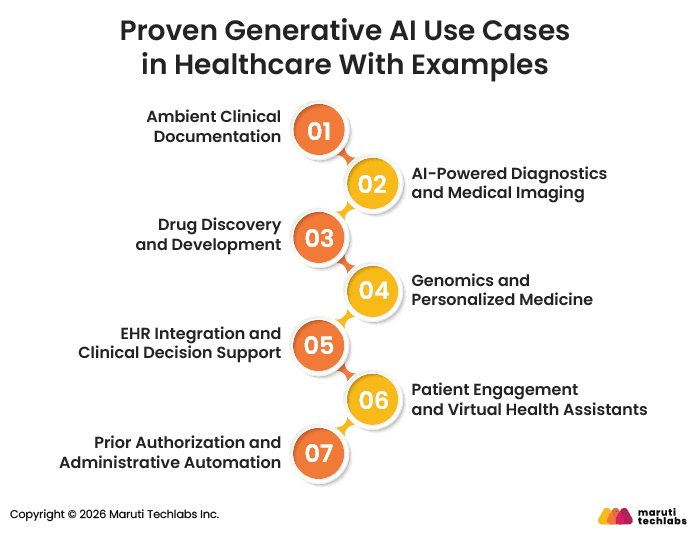
1. Ambient Clinical Documentation
Healthcare professionals spend a significant portion of their day documenting patient encounters, often leaving less time for direct patient care. Manual note-taking also increases the risk of incomplete records and clinician burnout.
Generative AI-powered ambient documentation tools use ambient listening to capture doctor-patient conversations, transcribe them in real time, and automatically generate structured clinical notes that clinicians can review, edit, and approve before adding them to the medical record.
Real-World Example
Mount Sinai Health System adopted Microsoft's Dragon Copilot to streamline clinical documentation workflows. The solution uses ambient listening and Generative AI capabilities to automatically create clinical notes, reducing administrative burden and helping physicians focus more on patient interactions.
2. AI-Powered Diagnostics and Medical Imaging
Healthcare organizations face growing volumes of imaging data while radiology and pathology teams struggle with staffing shortages. Reviewing thousands of scans and reports can be time-consuming and prone to delays.
Generative AI supports clinicians by summarizing findings, generating draft reports, enhancing image interpretation workflows, and consolidating information from multiple data sources.
Real-World Example
Google's MedLM, built on Med-PaLM technology, helps healthcare organizations process medical information and support clinical workflows. The platform has been used to assist with documentation, information retrieval, and diagnostic support, demonstrating how foundation models can augment clinical decision-making.
3. Drug Discovery and Development
Traditional drug development is expensive, time-consuming, and associated with high failure rates. Identifying promising compounds and validating them through laboratory and clinical testing often takes more than a decade.
Generative AI accelerates this process by identifying drug targets, designing novel molecules, predicting molecular interactions, and prioritizing promising candidates for further research.
Real-World Example
Insilico Medicine developed Rentosertib, a drug candidate generated using AI-driven discovery methods, to treat idiopathic pulmonary fibrosis. The program progressed from target identification to clinical trials significantly faster than traditional pharmaceutical development timelines, demonstrating the potential of AI-assisted drug discovery.
4. Genomics and Personalized Medicine
Every patient responds differently to treatments due to variations in genetics, lifestyle, environment, and medical history. Traditional treatment approaches often rely on generalized protocols that may not deliver optimal outcomes for every individual.
Generative AI can analyze large-scale genomic and clinical datasets to identify patterns, predict treatment responses, and support more personalized care decisions.
Real-World Example
Mayo Clinic partnered with Cerebras Systems to develop AI models capable of analyzing genomic data from more than 100,000 patients. The initiative aims to improve treatment personalization by identifying how individuals may respond to specific therapies.
5. EHR Integration and Clinical Decision Support
Electronic Health Records contain vast amounts of valuable patient information. However, clinicians often struggle to quickly locate relevant details buried within lengthy records.
Generative AI can summarize patient histories, surface critical information, recommend relevant guidelines, and draft responses to patient communications directly within existing workflows.
Real-World Example
Epic integrated GPT-4 capabilities into its EHR platform to assist healthcare professionals with patient communication, information retrieval, and clinical workflow support. By bringing AI directly into the systems clinicians already use, the solution improves efficiency without requiring major workflow changes.
6. Patient Engagement and Virtual Health Assistants
Patients often need support between appointments, whether for scheduling, medication management, follow-up care, or health-related questions. Traditional support channels can struggle to handle growing demand.
Generative AI-powered virtual assistants provide 24/7 support, helping patients access information and services more quickly while reducing pressure on healthcare staff.
Real-World Example
UC San Diego Health uses Generative AI within its Epic electronic health record system to help clinicians draft responses to patient messages. This enables faster and more personalized communication while reducing the administrative burden on healthcare teams. The health system also uses AI-enabled phone agents to help patients schedule appointments and access care more conveniently.
7. Prior Authorization and Administrative Automation
Administrative processes remain one of the largest sources of inefficiency in healthcare. Prior authorization workflows often require significant manual effort, leading to delays in care delivery and increased operational costs.
Generative AI can automate documentation collection, form completion, claims processing, and authorization requests while improving accuracy and reducing turnaround times.
Real-World Example
Humata Health partnered with Optum to automate prior authorization workflows using AI-driven automation. Integrated directly into EHR systems, the solution assembles clinical documentation, aligns submissions with payer-specific requirements, and submits authorization requests automatically. The platform has helped reduce manual touches by 45%, increase processing efficiency by 80%, and achieve a 96% first-pass approval rate.
Benefits of Gen AI in Healthcare
Generative AI benefits healthcare by reducing administrative burden, speeding up clinical decision-making, accelerating drug discovery and research, etc.
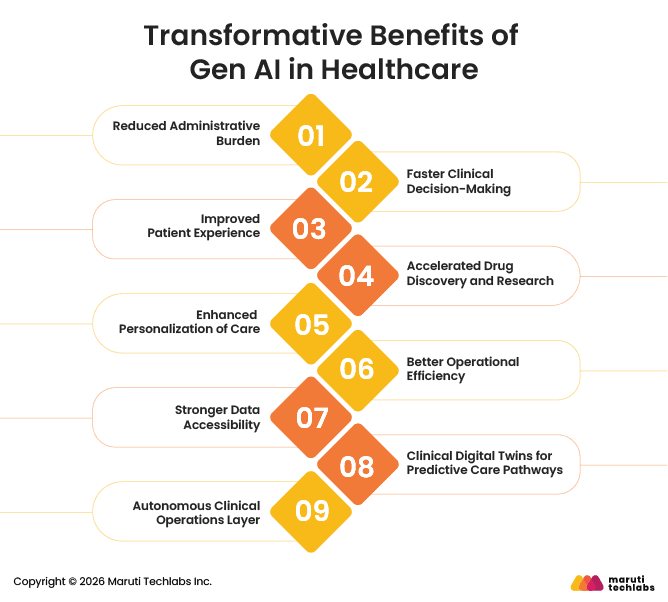
1. Reduced Administrative Burden
Administrative work remains one of the leading contributors to clinician burnout. Generative AI automates tasks such as clinical documentation, prior authorization preparation, patient communication, and report generation, allowing healthcare professionals to focus more on patient care.
2. Faster Clinical Decision-Making
Clinicians often need to review information from multiple sources before making care decisions. Generative AI can summarize patient records, surface relevant clinical guidelines, and consolidate critical information into actionable insights, reducing the time required to reach informed decisions.
3. Improved Patient Experience
AI-powered assistants provide patients with faster access to information, appointment scheduling, medication reminders, and post-treatment guidance. This improves accessibility while helping healthcare organizations deliver more responsive support.
4. Accelerated Drug Discovery and Research
Generative AI enables researchers to identify promising compounds, predict molecular interactions, and analyze vast scientific datasets more efficiently. This helps reduce development timelines and increases research productivity.
5. Enhanced Personalization of Care
By analyzing clinical, genomic, behavioral, and demographic data, Generative AI supports more individualized treatment recommendations and care pathways tailored to each patient's unique needs.
6. Better Operational Efficiency
Healthcare organizations can streamline claims processing, revenue cycle management, prior authorization workflows, and resource allocation through automation, helping reduce costs while improving productivity.
7. Stronger Data Accessibility
Healthcare data often exists in fragmented and unstructured formats. Generative AI makes this information easier to access, understand, and utilize by transforming complex datasets into meaningful insights that support decision-making across the organization.
8. Clinical Digital Twins for Predictive Care Pathways
Generative AI can help build continuously updated “digital twins” of patients by simulating how an individual’s health may evolve based on clinical history, genetics, lifestyle, and real-time monitoring data.
This allows clinicians to test multiple treatment scenarios virtually before applying them in real life, improving precision in care planning, reducing trial-and-error in treatments, and enabling truly predictive medicine instead of reactive care.
9. Autonomous Clinical Operations Layer
Beyond automation of individual tasks, Generative AI is moving toward acting as an intelligent coordination layer across hospital operations.
It can dynamically manage workflows such as bed allocation, staff scheduling, discharge planning, and emergency triage coordination by continuously interpreting live hospital data. This creates a self-optimizing system where operational decisions are made in near real time, reducing bottlenecks and improving system-wide efficiency.
Common Challenges in Implementing Generative AI in Healthcare
Implementing Generative AI in healthcare introduces significant hurdles related to data privacy, compliance, hallucinations, etc.

