Is Your Clinical AI Failing? The Human-in-the-Loop Framework You Need
A risk-tiered framework for designing, enforcing, and auditing human oversight in clinical AI.

Key Takeaways
Human oversight belongs at the decision point where an error becomes irreversible.
A risk-tiered framework (verification, augmentation, human-in-command) matches review depth to clinical stakes.
Enforcement patterns like interrupt hooks, per-tool logic, and async or real-time approval make checkpoints impossible to skip.
Rubber-stamping, alert fatigue, and undefined reviewer-unavailability behavior are engineering problems, not clinician failures.
A defensible audit log needs model version, policy version, reviewer identity, timestamps, and stated rationale, logged independently of the system it monitors.
Building this well requires agentic architecture, compliance-grade logging, and graduated autonomy working together, whether built in-house or with outside expertise.
Introduction
If your team is building AI into a clinical decision support system right now, the pressure is coming from two directions at once. Leadership wants the system shipped before a competitor gets there first. Compliance keeps asking what happens when the model gets it wrong, and a patient is on the other end of that mistake.
A June 2026 study in JAMA Network Open reviewed 903 FDA-authorized AI-enabled medical devices and found that 43 of them, close to 5 percent, were later recalled. The leading cause was not an exotic model failure. It was the device being used outside the boundaries it was actually validated for.
Meanwhile, the FDA's January 2026 guidance loosened oversight for many clinical decision support tools, transitioning more of that responsibility onto the engineering team building healthcare AI services.
Most teams respond by adding a review step and calling it human oversight, and that rarely survives contact with real clinicians under real-time pressure.
This guide covers exactly that: where human review belongs, what happens when a reviewer disagrees with the model, and how to prove that oversight was real.
Where Human Oversight Actually Belongs in a Clinical AI Pipeline?
Most teams treat "human in the loop" as a single design decision, applied once, somewhere near the end of the pipeline. That alignment is the root of most failed implementations.
A clinical AI system moves through several distinct decision points before it reaches a patient, and each one carries a different level of risk. Oversight needs to be placed where an error becomes irreversible, not where inserting a review is operationally convenient.
Four decision points in a clinical AI pipeline and where oversight actually matters
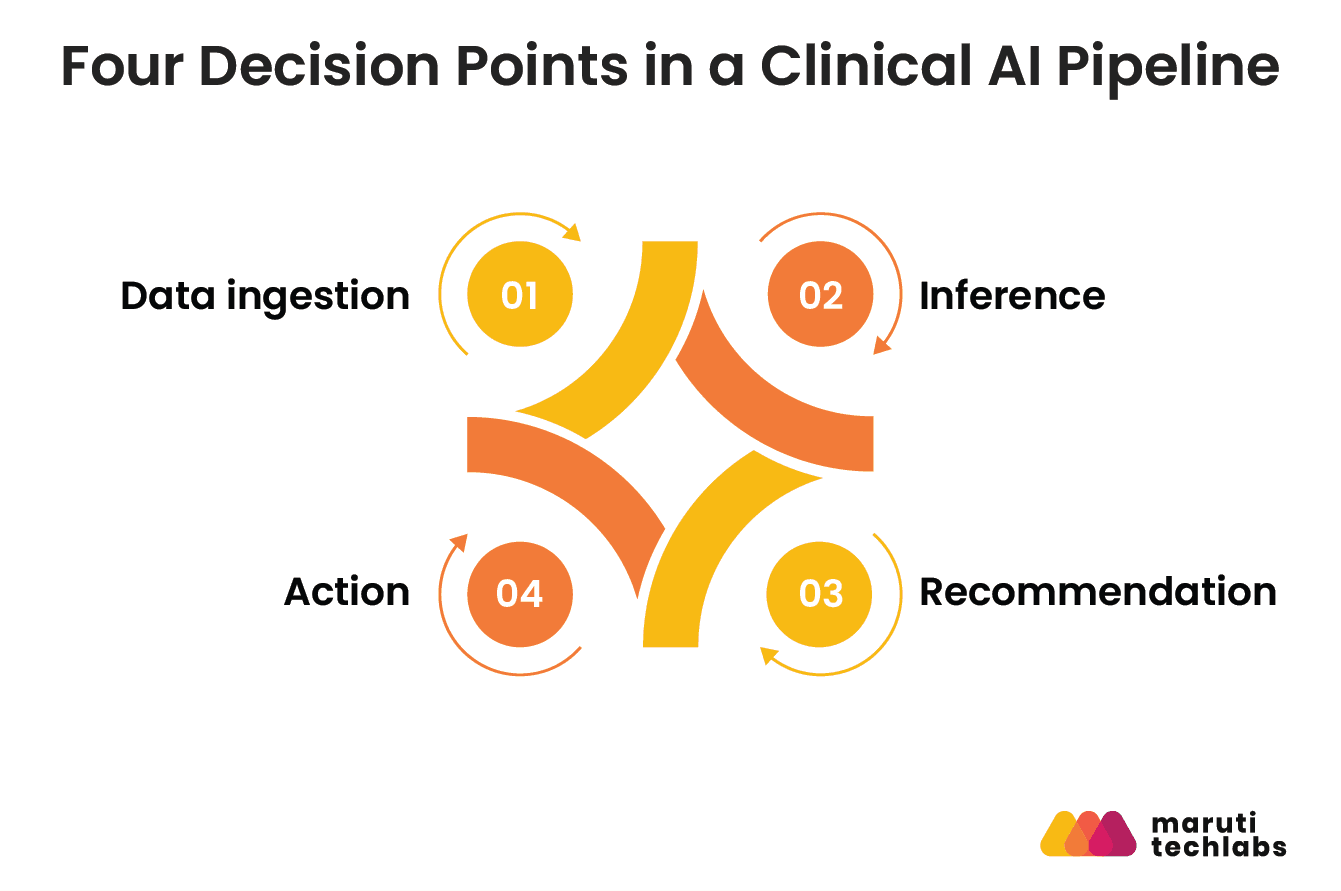
1. Data ingestion
This stage defines the factual boundary of the system. Whatever enters here becomes the basis for every downstream decision the model makes.
A stale medication list or a missing allergy flag introduced at this point propagates silently across outputs. These errors are the least visible but the cheapest to correct, which is why they are often overlooked.
2. Inference
At this stage, the model translates input data into predictions or recommendations that will later influence clinical judgment. It is the point most teams associate with “the AI” itself.
Review here can intercept flawed reasoning before it is formalized into advice, but it only works if the system can expose how the output was derived, not just what it produced.
3. Recommendation
Here, the model’s output is contextualized and presented to the clinician as a score, rank, or alert that shapes decision-making. The risk shifts from correctness to interpretation.
Oversight at this layer must evaluate whether the output is framed in a way that encourages critical evaluation. Poor presentation increases automation bias, even when the underlying prediction is technically sound.
4. Action
This is the point where the system’s output translates into real clinical intervention, such as ordering treatment, adjusting dosage, or initiating discharge. The consequence is no longer theoretical.
A checkpoint placed here identifies errors only after they have influenced care. In scenarios where actions are irreversible, this stage is too late for meaningful intervention.
Why this sequencing matters
Placing the human checkpoint at inference or recommendation catches an error before it becomes consequential.
Placing it at action means oversight exists on paper but arrives too late to change the outcome.
The JAMA Network Open recall analysis points to exactly this gap. Devices were not failing at the model level. They were being used past the boundary of what they were validated to do, which is a decision-point problem rather than an accuracy problem.
Human-in-the-loop v/s Human-on-the-loop
Human-in-the-loop means the system cannot act until a person approves that specific output.
- Right fit for high-risk, low-volume decisions where every case needs individual sign-off.
Human-on-the-loop means the system acts autonomously, and a person supervises the pattern of behavior, intervening only when something looks wrong.
- Right fit for high-volume, lower-risk decisions where per-case review would be a bottleneck rather than a safeguard.
Both are legitimate architectures. Neither is a default. Choosing between them by convenience instead of by risk tier is how oversight ends up decorative instead of functional.
The actual question to answer for every clinical AI decision
Which of the four decision points does the human sit at?
Can that person actually stop the action in question before it happens, not just log a disagreement after?
Does that placement match the clinical stakes of what the model is doing?
How Do You Build a Risk-Tiering Framework for Clinical AI?
Once oversight is placed at the right decision point, the next question is how much oversight a given decision actually needs. Treating every AI output with the same level of scrutiny wastes review capacity on low-risk cases and starves the genuinely dangerous ones of attention.
The fix is a risk tier that maps directly to the clinical stakes of the decision, not to how the engineering team happened to build the pipeline.
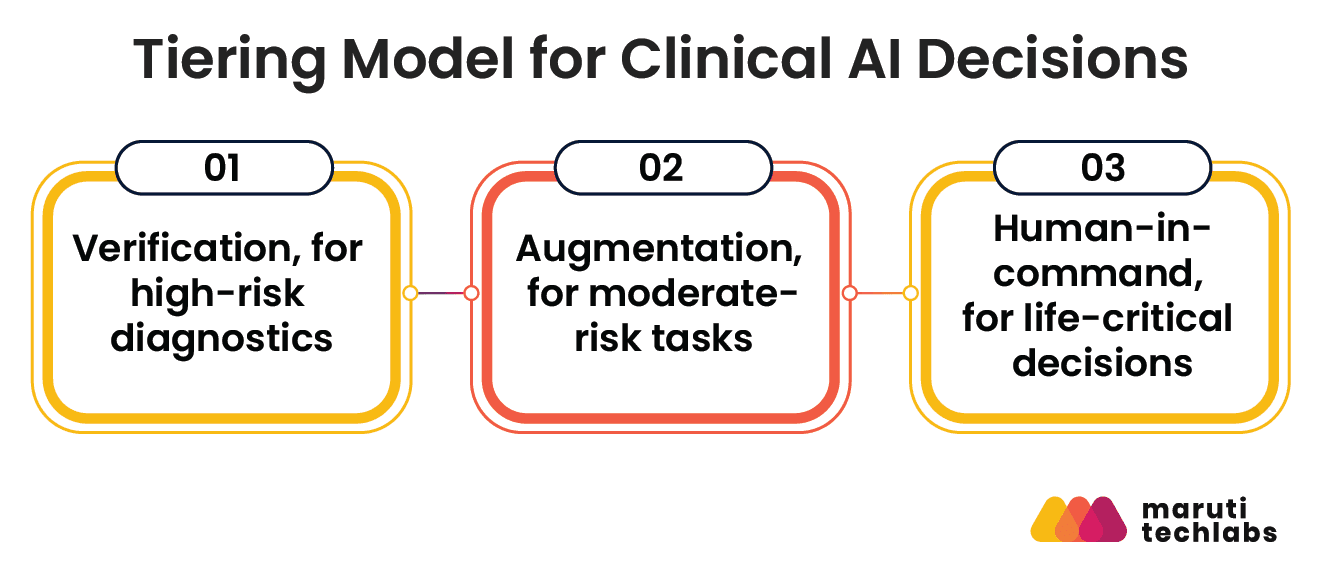
Tier 1 - Verification, for high-risk diagnostics
Applies to radiology, pathology, and any case where a wrong output directly changes a treatment path.
Every AI recommendation gets reviewed before it reaches the patient record. No exceptions, no confidence-based bypass.
This tier accepts slower throughput as the cost of catching errors that would otherwise be irreversible.
Tier 2 - Augmentation, for moderate-risk tasks
Applies to patient triage, risk scoring, and similar decisions where the AI assists but does not make the final call.
The clinician sees the AI output alongside their own judgment rather than as a replacement for it.
This is also where placement inside the workflow matters most. Clinicians who review AI output at the same time as forming their own judgment get better results than clinicians who form a judgment first and check the AI second.
Tier 3 - Human-in-command, for life-critical decisions
Applies to ICU management, surgical planning, and any context where the consequences of an error are immediate and severe.
The clinician retains full control. The AI provides information and options, never a default action.
Speed is not the priority here. Getting the decision right is.
What decides which tier a use case falls into
Reversibility - Can a wrong output be caught and corrected before it affects the patient, or is the action final the moment it happens?
Ambiguity - Does the case sit inside the AI's training distribution, or does it involve rare presentations, conflicting data, or incomplete history?
Regulatory Exposure - The FDA's 2026 guidance and the EU AI Act's Article 14 both put the burden of proving appropriate human oversight on the deploying organization, not on the model's stated accuracy.
Clinician Expertise on the Receiving End - The same AI assistance produces different results depending on who is reviewing it, with less experienced clinicians benefiting more than senior ones. A tier built around a junior-heavy team may need tighter review than one built around senior specialists.
Why this framework has to be explicit, not implicit
An undocumented risk tier means the tier was decided by whoever built the pipeline, under whatever time pressure existed that sprint, not by a deliberate risk assessment.
A documented tier gives compliance something concrete to audit and gives engineering a clear target to build against, instead of a vague instruction to "add human oversight."
The tier also determines which architecture pattern fits, which is the subject of the next section.
Architecture Patterns for Enforcing the Loop (Not Just Requesting It)
A risk tier only matters if the system actually enforces it. Telling an AI agent to "ask for approval" is an instruction, not a constraint, and instructions get skipped under load, misconfigured, or quietly bypassed by a well-meaning engineer trying to unblock a demo.
The patterns below are ways to make the checkpoint structurally impossible to skip, not just documented as a best practice.